
Glossary of Children's Footwear Terms
Choosing shoes for your child can sometimes mean learning a whole new vocabulary: fit, heel counter, heel-to-toe drop, insole… Since 1973, our design studio in Chanverrie, in the Vendée region, has been creating our own last shapes and patterns for children’s feet, from their first steps to walking on their own. Here are the terms we use every day, explained in simple terms.
A-Z Index
Barefoot · Design Office · Anti-Twist © Shank · Rubber · Toe Cap · Fit · Heel Counter · Instep · Edge-to-Edge Stitching · Side Stitching · Turned Stitching · Vegetable-Tanned Leather · Grained Leather · Nubuck Leather · Full-Grain Leather · Suede · Upper · Lining · Drop · Upper · Last · Guarantors · Construction · Traditional Sandal Stitch Construction ·
Positano Construction · Strobel Construction · Traditional Construction · Foot Morphology
· Trimming · Pattern Making · Shoe Size · Insole · Prototype · Sole ·
Memory Foam Sole · Removable Sole · Non-Slip Sole · Shore ·
Walking Stage · Toe Box · Canvas · YKK Zipper
The shoe
Shoes
All the characteristics of a shoe that allow it to fit the foot properly and comfortably: the size, as well as the width, volume, and construction.
For your child: Two pairs of shoes of the same size can fit very differently. A good fit supports the foot without squeezing it and leaves room to move.
Size
Shoe size, determined by the length of the foot.
For your child: Measure their foot at the end of the day, when it’s at its longest, and leave a little extra room at the toes. As they grow, check the fit regularly. Learn how to choose the right shoe size.
Instep
The upper part of the foot, between the ankle and the toes.
For your child: A wide instep requires a roomier shoe; if the instep is narrow, choose a shoe that provides good support for the top of the foot.
Anatomy of the Foot
Each foot has its own unique shape: its length, width, instep volume, and toe length (Egyptian, Greek, or Roman foot).
For your child: Every foot is different, right from the very first steps. At Pom d’Api, our shoe shapes are designed for narrow, standard, or wide feet.
Walking Stage
Stages of learning to walk. Pom d’Api identifies four stages: pre-walking, first steps, confident walking, and independent walking.
For your child: Each stage calls for the right fit: the right flexibility, support, and protection—at just the right time.
The Components and Features of the Shoe
Upper / shaft
The upper part of the shoe, which wraps around the foot.
For your child: The upper provides support for the foot; made of leather, it remains flexible and breathable.
Lining
The inner part of the shoe that comes into contact with the foot.
For your child: A leather lining follows the foot’s natural movements while providing comfortable support, and gradually molds to the shape of the foot. It also allows the foot to breathe and helps keep moisture at bay, ensuring comfort all day long.
Clean Sheet Debut
The insole of a shoe, on which the foot rests.
For your child: At Pom d’Api, all of our first-step training pants are made of leather—breathable and comfortable.
Insole
The part of the shoe that comes into contact with the ground.
For your child: For those first steps, shoes should be thin and flexible; when your child runs and jumps, they should also be durable.
Removable insole
A removable insole that can be taken out of the shoe for better daily hygiene.
For your child: You can take it out to let it dry.
Memory foam insole
Foam insole that conforms to the shape of the foot.
For your child: Extra comfort without compromising the shoe's flexibility; this feature is particularly notable in the Yaka barefoot line.
Non-slip sole
Outsole designed to grip the ground.
For your child: A must-have from their very first steps, and even more so when they're running and jumping.
Hood
A reinforcement placed at the front of the shoe, above the toes, to protect it from friction and impact.
For your child: Useful when they're still crawling around or when they kick their shoes while playing.
Buttress
A semi-rigid support located at the back of the shoe, between the upper and the lining, to hold the heel in place.
For your child: A well-supported heel helps with balance. Yaka barefoot shoes, on the other hand, don’t have a rigid heel counter, so the heel remains free.
Upper
The front part of the upper, which covers the instep and the toe of the shoe.
For your child: This is the area that bends with every step; it needs to be flexible to follow the foot's movement.
Anti-Twist Cable ©
A reinforcing piece integrated into the sole at the heel that limits the shoe's twisting. At Pom d’Api, this Anti-Twist© shank is patented.
For your child: Part of the Stand-Up "First Steps" line, this shoe helps prevent ankle twists while maintaining great flexibility in the forefoot.
Barefoot
An English word meaning “barefoot.” A barefoot shoe mimics the experience of walking barefoot as closely as possible: a thin, flexible sole; zero or minimal heel-to-toe drop; and a wide toe box.
For your child: This is the essence of our Yaka line, featuring a wide toe box, a flexible sole, and a minimal heel-to-toe drop of 1 mm, allowing the foot to move freely.
Drop
The difference in height on the sole between the heel and the front of the shoe.
For your child: A “zero-drop” sole is flat, just like bare feet—this is one of the defining features of barefoot shoes. Yaka barefoot models have a minimal drop of 1 mm.
Toe box
An English term referring to the front part of a shoe, where the toes are located.
For your child: A wide toe box allows the toes to spread out naturally; this is one of the principles of barefoot footwear.
Shore
An index that measures the hardness of a sole.
For your child: At Pom d’Api, the material of our insoles is carefully selected—neither too stiff nor too flexible—and designed with children’s feet in mind.
YKK zipper
YKK zipper, located on the inside of the shoe, with a self-locking slider.
For your child: A reliable, high-quality clasp that won't slip.
Construction and Types of Assembly
Side seam
A construction in which the insole is sewn to the side of the shoe; the seam remains visible on the side.
For your child: A sturdy design that will last.
Inside-out stitching
A construction technique in which the shoe is sewn inside out and then turned right side out, so that the seams are on the inside.
For your child: A very flexible shoe that provides a feeling of absolute freedom, just like walking barefoot.
Seam-to-seam stitching
A method of assembly in which leather pieces are placed edge-to-edge without overlapping.
For your child: This results in a flexible, lightweight shoe with no excess bulk, which means there’s less risk of chafing on the foot.
Strobel Assembly
A process that involves stitching the upper all around a flexible insole before attaching the outsole.
For your child: A construction that offers lightness, flexibility, and durability; the shoe moves with every step.
Traditional assembly
Traditional construction: The upper is stretched over the last, then secured under a lining before the insole is installed.
For your child: A shoe that holds its shape well and provides good support for the foot.
Traditional Stitched Sandal Construction
A construction method specific to sandals: the top edge is folded outward and sewn directly onto the sole.
For your child: A design that offers flexibility while remaining sturdy.
Positano Montage
A handcrafted technique that joins the upper and the sole using a specific construction method.
For your child: A flexible, lightweight, and comfortable shoe that moves with the foot.
Materials
Nubuck leather
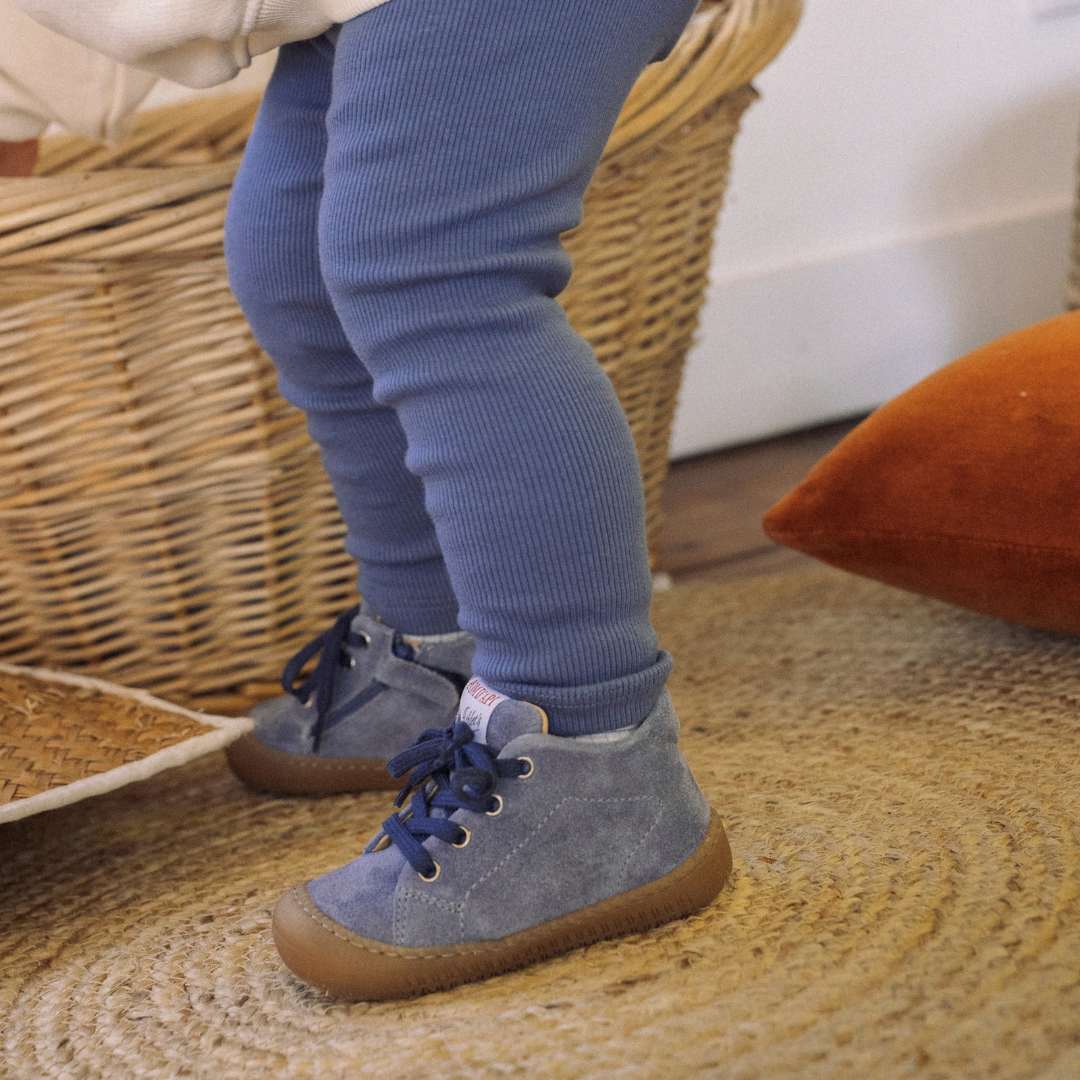
Leather whose surface has been finely sanded to give it a soft, velvety appearance.
For your child: This item is more delicate; care for it with a crepe brush and protect it with a waterproofing spray.
Suede leather
The underside of the leather, finely sanded for a soft, velvety feel.
For your child: Soft to the touch; brush it dry once the shoe is completely dry.
Full-grain leather
Leather that has retained its intact outer surface: this is the finest part of the hide. It is soft and helps regulate body temperature.
For your child: Durable leather that ages well, perfect for active days.
Grained leather
Leather with a textured surface—either natural or embossed—that gives it a distinctive feel.
For your child: Its texture makes it less prone to minor everyday marks; a soft cloth is all you need to clean it.
Vegetable-tanned leather
Leather tanned using plant-based tannins (wood, bark, leaves, fruit) according to a traditional method that can take up to 40 days. It is supple, durable, and develops a natural patina over time.
For your child: At Pom d’Api, the insole of the sandals—where the bare foot rests—is made of vegetable-tanned leather.
Canvas
A lightweight fabric, often made of cotton, that is soft and breathable, ideal for hot summer days.
For your child: Lightweight and comfortable on sunny days, it can be cleaned with a damp sponge and a little mild soap, then left to air dry.
Rubber
A material used for the outsole that is abrasion-resistant and provides good traction.
For your child: At Pom d’Api, all of our outsoles are made of rubber and manufactured in Portugal using custom Pom d’Api molds.
Manufacturing
Engineering Firm
The team that designs and develops the models: shapes, materials, prototypes.
For your child: Pom d’Api is located in Chanverrie, in the Vendée region; every design is conceived and created there.
Form
A wooden or plastic last that replicates the shape of the foot and is used to make shoes.
For your child: Pom d’Api shoe styles are designed by our engineering department for narrow, standard, or wide feet.
Sponsorship
A step that involves drawing, based on the last, all the parts that make up the shoe.
For your child: Their comfort depends on it: well-fitting clothes prevent wrinkles and chafing.
Prototype
First model built for testing prior to production.
For your child: At Pom d’Api, every prototype is tested by children at partner schools in the Vendée region and at early childhood education centers.
Hoof Trimming
A technique that involves thinning the leather to make it more supple.
For your child: This is what makes the edges of the shoe more flexible and comfortable.
Guarantors
Attached pieces featuring eyelets or another type of fastener.
For your child: When positioned correctly, they allow you to adjust the lacing to fit the shape of your child's foot.
Editing
The process of positioning the top perfectly on the form in order to assemble it.
For your child: Precise construction ensures a shoe that fits securely, without creases or chafing.